

Market Performance and Technical Outlook
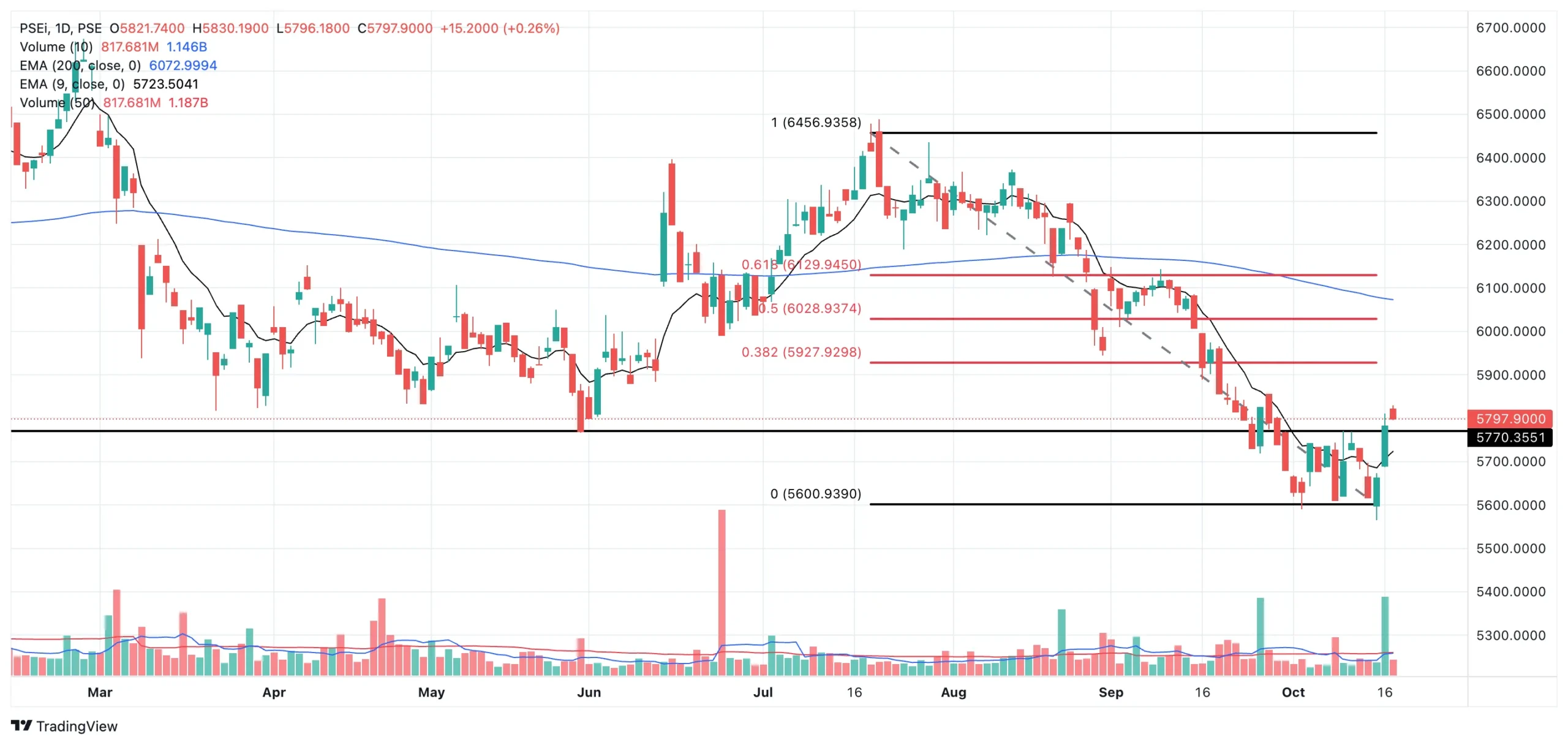
The Philippine Stock Exchange Index (PSEi) closed at 5,797.90 on Monday, October 19, 2026, gaining 15.20 points or 0.26% from Friday’s close. Despite the advance, the main bellwether index failed to sustain the stronger trading volume recorded in the previous session, suggesting that buying momentum remains limited.
Nevertheless, trading volume remained above 50% of its 10-day average, based on the available technical data. Although this indicates continued market participation, the decline in volume suggests that investors have yet to establish a stronger buying trend.
The PSEi’s immediate support level stands at 5,770, while resistance is pegged at 5,930, coinciding with the 38.2% Fibonacci retracement level. The index needs to advance toward 5,860 to improve its chances of challenging resistance. Failure to build upward momentum could result in another test of the 5,770 support level.
A sustained move toward resistance would strengthen the recovery outlook, while a breakdown below support could expose the index to further selling pressure. For now, the market’s modest gain does not establish a definitive bullish reversal.
Sector Performance and Market Breadth
The Holding Firms sector led the advance, followed by Financials, Industrial, and Mining and Oil. In contrast, Services and Property weighed on the overall market performance, reflecting uneven investor sentiment across industries.
The market recorded 99 advancers against 67 decliners, producing an advance-decline ratio of 1.48. This indicates positive market breadth, as advancing stocks outnumbered declining stocks. However, positive breadth should not be interpreted as conclusive evidence of a strong bullish trend, particularly given the index’s modest gain and weaker trading volume.
The Philippine Stock Exchange reported total market turnover of approximately ₱5.87 billion for the session. While the index and market breadth posted positive results, the mixed sector performance suggests that investors remain selective rather than broadly committed to the market’s recovery.
Philippine Macroeconomic Developments
Domestic inflation and currency movements remain important considerations for the Philippine equity market.
Philippine headline inflation accelerated to 7.2% in September 2026 from 6.1% in August, while core inflation rose to 4.7% from 4.1%. Higher food prices, housing and utility costs, and transportation expenses contributed to the acceleration. These developments can constrain household purchasing power, increase business operating expenses, and weigh on corporate earnings.
The peso’s depreciation also presents challenges for companies dependent on imported raw materials, fuel, equipment, and other dollar-denominated inputs. Exporters and companies receiving substantial dollar revenues may benefit from currency conversion, but the overall effect depends on their cost structures, foreign-currency liabilities, and hedging arrangements.
Monetary policy remains another important consideration. Persistent inflation and currency weakness may limit the BSP’s flexibility to ease borrowing costs. Higher interest rates can constrain credit growth, consumer spending, business investment, and equity valuations. Banks may benefit from improved lending spreads under certain conditions, although loan demand, funding costs, and asset quality remain important considerations.
These domestic conditions create a challenging environment for equities. Persistent inflation, currency depreciation, and the possibility of tighter monetary policy could limit the PSEi’s upside, even as selective buying supports short-term recoveries.
International Macroeconomic Developments
Global inflation, interest-rate expectations, geopolitical risks, and developments in major economies continue to influence emerging-market equities.
In the United States, September inflation reached 3.7% year-on-year, exceeding expectations and reinforcing concerns about persistent price pressures. The possibility of tighter monetary policy could support the US dollar and make dollar-denominated assets more attractive relative to emerging-market investments. For the Philippines, this could contribute to foreign capital outflows and additional pressure on the peso, although actual market effects depend on relative valuations, domestic fundamentals, and investor risk appetite.
China’s economy grew by 4.5% year-on-year in the third quarter of 2026, accelerating from 4.3% in the preceding quarter. Strong exports supported growth, but weak domestic consumption and continued weakness in the property sector remain concerns. China’s economic performance matters to the Philippines through regional trade, commodity demand, manufacturing activity, and broader investor sentiment toward Asian markets.
Oil prices and geopolitical developments also warrant close monitoring. On October 19, global markets assessed uncertainty surrounding US sanctions on Russian oil, shipping risks, and tensions in the Middle East. Although oil futures eased, risks to physical supply and shipping costs remained. For the Philippines, sustained increases in energy prices could raise transportation, electricity, and manufacturing costs, aggravating inflationary pressures. Conversely, a sustained decline in oil prices could help moderate imported inflation and reduce business expenses.
These international developments create mixed implications for the PSEi. Stronger regional economic activity could support Philippine exports and business confidence, but persistent inflation, elevated borrowing costs, and geopolitical uncertainty could weigh on valuations and foreign investor appetite for emerging-market equities.
Microeconomic Considerations and Corporate Earnings
At the company level, investors should focus on third-quarter earnings expectations, operating margins, financing costs, and exposure to foreign exchange movements.
Companies with substantial imported inputs or dollar-denominated debt may face higher costs as the peso weakens. Businesses dependent on domestic consumer demand could encounter pressure as inflation reduces household purchasing power. Property developers and other capital-intensive businesses may also face higher financing costs if borrowing rates remain elevated.
Conversely, exporters and firms with significant dollar-denominated revenues may benefit from peso depreciation, depending on their cost structures and foreign-exchange exposure. Companies with strong balance sheets, pricing power, and relatively stable cash flows may be better positioned to withstand economic uncertainty.
The gains in Holding Firms, Financials, Industrial, and Mining and Oil, alongside weakness in Services and Property, indicate uneven performance across sectors. Company-specific earnings, debt exposure, operating margins, and business outlooks therefore remain important considerations when evaluating individual stocks.
Foreign investor activity should also be monitored alongside turnover and market breadth. Sustained foreign buying and stronger trading volume would provide additional evidence of improving market confidence. Without such confirmation, an increase in the index may reflect selective buying rather than a broad recovery in investor sentiment.
Overall Assessment
The PSEi’s 0.26% gain on October 19 represents a modest improvement in market performance, supported by positive market breadth and gains in several sectors. However, weaker trading momentum and uneven sector participation suggest that the recovery remains tentative.
Domestically, accelerating inflation and peso depreciation create challenges for consumer spending, corporate margins, and monetary policy. Internationally, US inflation and interest-rate uncertainty remain potential headwinds, while China’s economic growth offers a mixed regional outlook and energy-market volatility presents both risks and potential relief.
Technically, the index needs to move toward 5,860 to improve its chances of challenging the 5,930 resistance level. The 5,770 support level remains important should upward momentum weaken.
The near-term outlook is cautiously neutral. A more convincing bullish signal would require stronger buying momentum and sustained market participation, while a failure to hold support could renew selling pressure. Investors should continue monitoring domestic inflation, peso movements, monetary policy, global energy prices, foreign investor flows, and corporate earnings for signals that could influence the PSEi’s next move.