

Price Behavior and Technical Setting
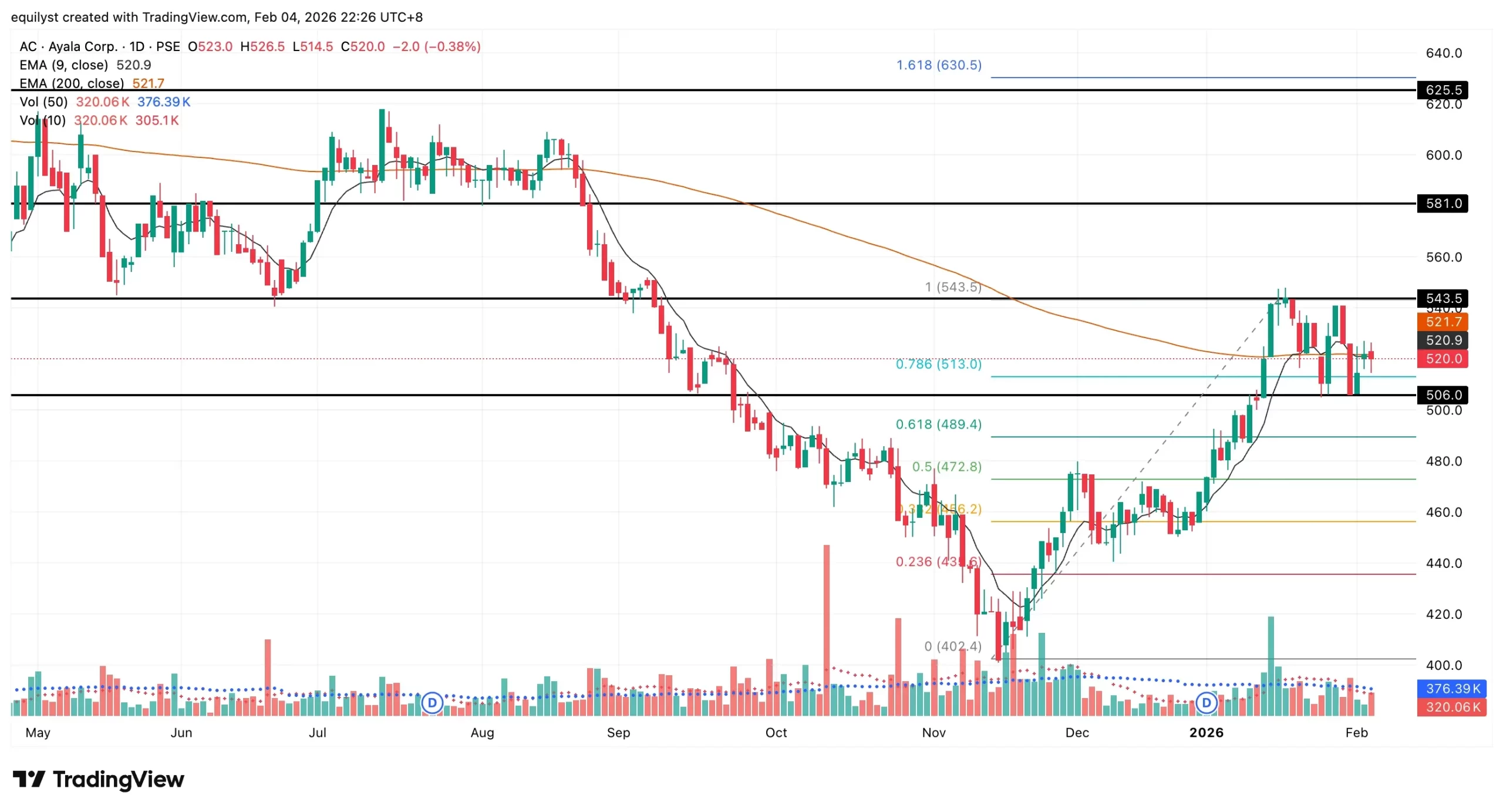
Ayala Corporation (AC) struggled to assert direction as price hovered near the convergence of its 9-day and 200-day exponential moving averages. The stock closed at ₱520.00, down 0.38%, on February 4, 2026, which underscores continued friction at a critical technical junction.
The session ended with a red close supported by volume that approached, but did not exceed, its 10-day average. This level of activity points to engagement without decisive commitment from either side.
AC currently trades within a narrow band defined by immediate support at ₱506.00 and resistance at ₱543.50. Should muted price movement persist alongside elevated red volume near the 10-day average, downside risk increases. Under such conditions, a break below immediate support could open the door to a retest of the longer-term floor near ₱489.00, which aligns with the 61.8% Fibonacci retracement.
Dominant Range and Intraday Control
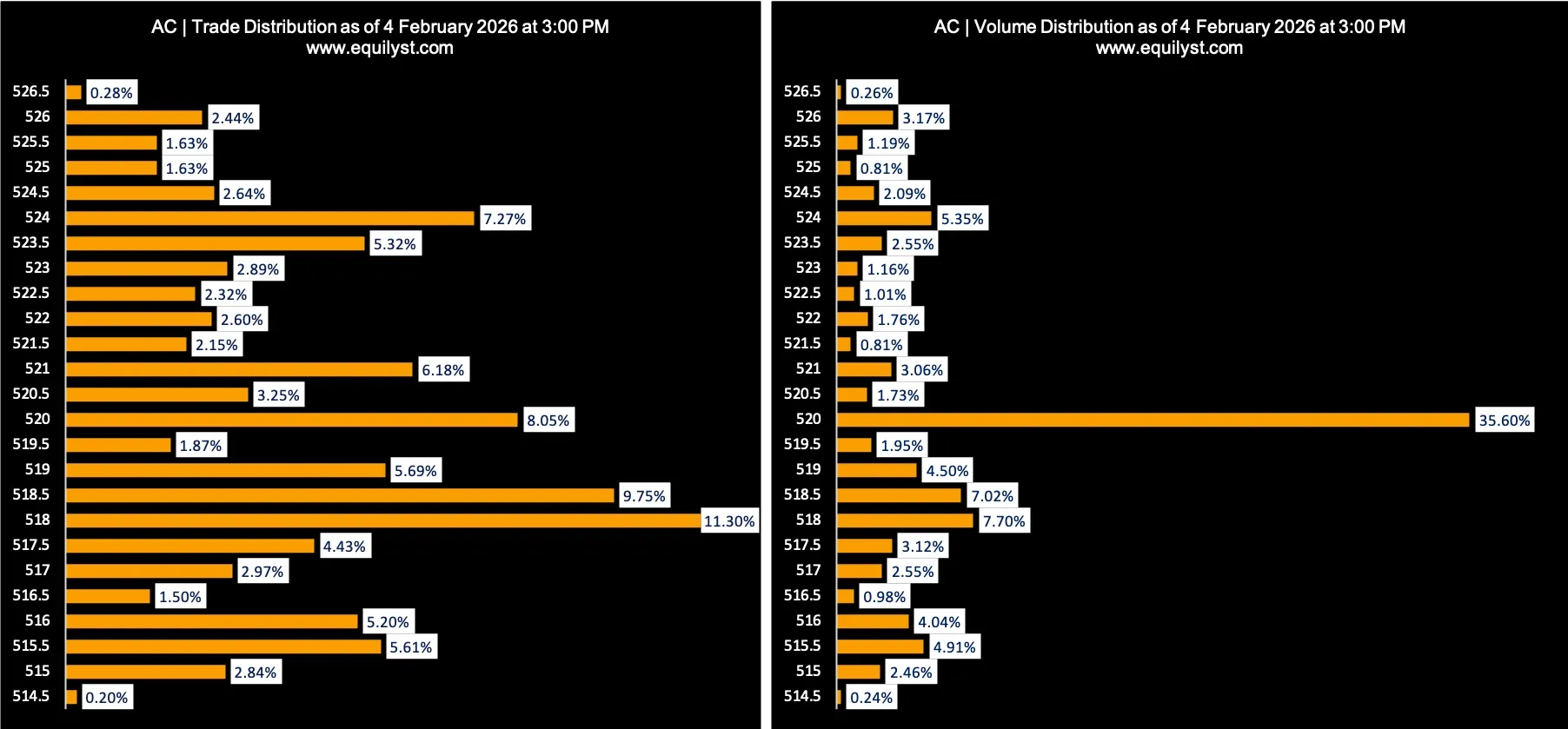
Although the last traded price settled marginally above the volume-weighted average price, the session’s heaviest trading activity clustered near the upper end of the intraday range. This placement indicates difficulty in sustaining price acceptance at higher levels.
Given this distribution, the proprietary Dominant Range Index issued a bearish signal for the session.
Dominant Range Index: BEARISH
Last Price: ₱520.00
Dominant Range: ₱518.00 – ₱520.00
VWAP: ₱519.8348
Broker Activity and Sentiment Readings
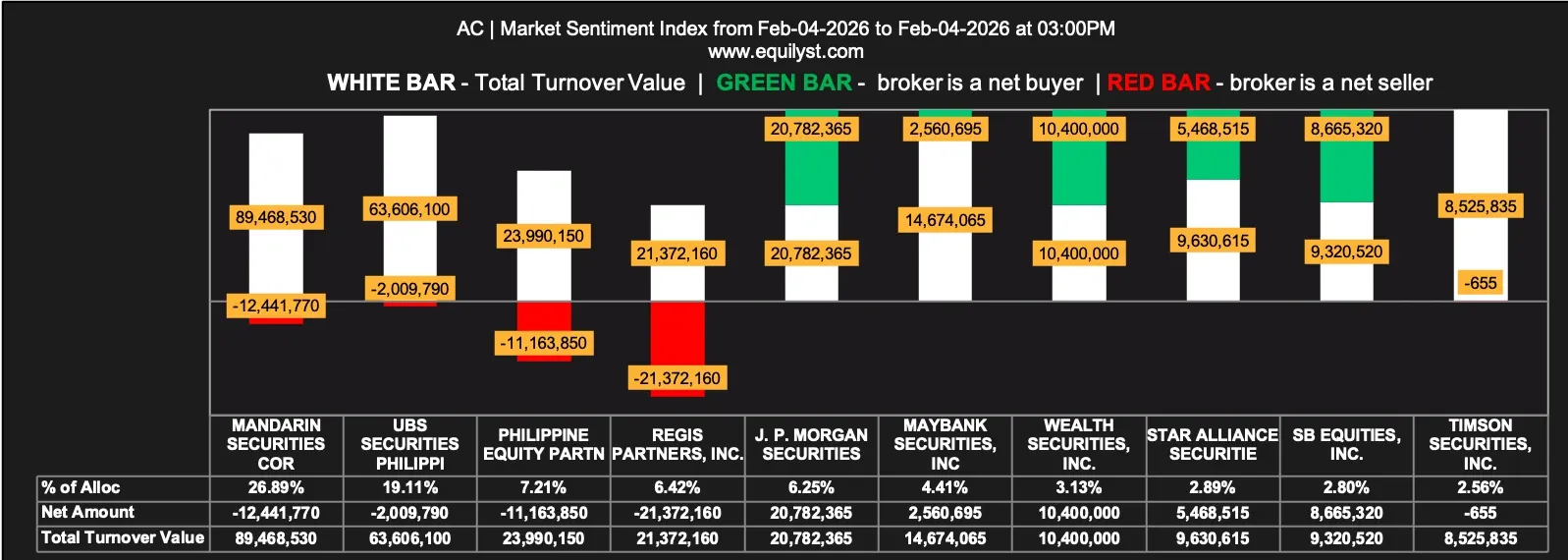
In contrast to the cautious price setup, the proprietary Market Sentiment Index delivered a bullish and contrarian signal. More than half of the participating brokers posted both a positive net amount and a higher buying average than selling average, which points to underlying accumulation interest beneath the surface.
This divergence highlights a market split between hesitant price action and constructive broker behavior.
For investors who monitor broker flows, activity from Mandarin Securities, UBS Securities, and CLSA Philippines deserves attention, as these firms rank among the most active traders of AC on a year-to-date basis.
Market Sentiment Index: BULLISH
20 of the 37 participating brokers, or 54.05%, posted a positive Net Amount
20 of the 37 participating brokers, or 54.05%, recorded a higher Buying Average than Selling Average
37 Participating Brokers’ Buying Average: ₱519.83745
37 Participating Brokers’ Selling Average: ₱520.80025
10 of 37 participants, or 27.03%, registered a 100% BUY activity
6 of 37 participants, or 16.22%, registered a 100% SELL activity
Long-Term Investor Perspective
From a long-horizon viewpoint, AC remains within a broad consolidation phase rather than a confirmed breakdown. As long as price holds above the ₱489.00 historical support, short-term weakness near the moving average cluster carries limited consequence for long-term positioning.
Long-term investors may place greater weight on AC’s ability to stabilize within the current range and eventually reassert separation above the converging averages. A sustained breach below ₱489.00 would justify a reassessment of downside risk, while renewed strength above ₱543.50, supported by improving participation metrics, would strengthen the longer-term constructive case.
Further Context and Structured Review
Additional context or structured review support may be requested through the consultancy form below.